|
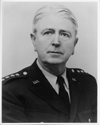
into the “forbidden” political arena, urged a strategy that would deny the Russian Communists an opportunity to supplant the hated Nazi rule with a tyranny just as odious. This was a ticklish area and often he had to hold back. Now in China there was no need to pull his punches. He unlike many others, knew that a Communist take over of China would be the worst possible outcome, and he sought, with all his power to prevent that, by recommending constructive measures to aid the Nationalists. He immediately appointed Colonel Ivan Yeaton, formerly a military attaché in Moscow to the United States Observation Group in Yenan, and from him Wedemeyer received many excellent reports about the Communists, and their subversive activities, all of which confirmed his understanding of what they were about. Wedemeyer made it is business to confer with Mao and Chou En-lai in his headquarters in Chunking and learned directly from them that their chief interest was to advance Communism; fighting Japanese, was secondary, and they were not adverse, indeed welcomed, aid from Russia.[1] There is one remarkable passage on page 286 of Wedemeyer Reports! where Wedemeyer, in one of these several meetings in Chunking with Mao and Chou En-lai levels both barrels at them strongly accusing them of falsely pretending to be “agrarian reformers” supposedly interested in ending poverty and espousing humanitarian principles. He accused them of using this tactic simply as a subterfuge in order to deceive the people and achieve power, and then after achieving power, denying free speech, freedom to worship, the right to determine how they should be governed, and introducing and inflicting torture and imprisonment to dissenters, as well as all the other totalitarian measures to attain and maintain power. Mao and Chou en-Lai, unused to being spoken to in this accusatory tone were dumbstruck. Greatly aroused by the charges they excitedly sought to deny them, but curiously, in heatedly attempting to deny them, they fell into the rhetorical error of actually admitted them by seeking to “justify” their conduct as “necessary” in their struggle to win the battle against the Nationalists and in the process destroy capitalism. The exact opposite of what Wedemeyer was charging them with (and which they failed to effectively refute) was being widely disseminated by willing dupes in the United States, and absorbed and believed by a gullible public and American politicians. No better proof of the sympathic attitude of a large portion of the American public, the press, and the political establishment toward the Chinese Communists and against the Nationalist government can be presented that a column written by the highly influential Drew Pearson in June 1945:
There is a lot more than meets the eye behind the arrest of two State Department officials and one Naval officer on a charge of passing out secret documents to magazine writers. Chief factor behind it is the intense cut-throat rivalry between two Chinese factions—Chiang Kai-shek’s War Lords in the South of China, and the so-called Chinese Communists, actually an agrarian party, in the north. Mixed up in all this is the action of the Chinese Secret Service operating under cover in the USA against anyone opposed to Chiang Kai-shek. …
It so happens that all three of the young Far Eastern experts arrested…feel ardently that the USA is backing the wrong horse in China. They feel that the northern Chinese Government [sic] is much more representative of the Chinese people, has done more fighting against Japan and that Chiang Kai-shek is chiefly and important prisoner of his own southern War Lords. Moreover, these three are not alone in this belief. General Stilwell emphatically believed it and was ousted from China as a result. John R. Davies, Secretary of the American Embassy, also believed it and was ousted…Also John Service, another Secretary of the Embassy, believed it, and was fired…Finally, US military men solely concerned with winning the war quickly feel that the Northern Chinese can be a vitally important factor in defeating Japan…[2] (emphasis added)
This is an astonishing and highly inaccurate report in numerous respects. Apart from its clearly one sided prejudiced viewpoint Pearson is wrong about the Communists being more representative, about the Communists doing more fighting the Japanese, and wrong about the reasons for Stillwell’s firing. Yet, Pearson was, sadly, reflecting the view of many Americans.
Wedemeyer was also convinced that the Nationalists, unlike the Communists, truly did want to fight the Japanese. After all they had been doing so almost single-handedly since 1937 with no more than a trickle of aid.[3] In addition to fighting the Japanese, the Nationalists also had to contend with the Chinese Communists who withdrew from the united front and directed their efforts against the Nationalists instead of fighting Japan. It was not until much later after the war, when it was too late, that the true motivation of the Communists became known. Mao Tse-tung had as early as 1937 recognized the unique opportunity the Sino-Japanese war afforded them to advance their cause. His instructions to his followers were to conceal their real intentions, pretending support for the Nationalists while dividing their efforts 70% toward expansion, 20% against the Kuominting and 10% in resisting Japan.[4] Wedemeyer, of course could not have known of this secret directive, but intuitively he early on became aware from their statements, and their conduct that this was their plan.
Wedemeyer also came to realize that the American interest in China was limited and selfish. She was expected, despite her weakened state, to exert every effort to assist the United States in the defeat of Japan. Few knew or cared how hard and how successfully China had resisted the Japanese from 1937 to the start of World War II. The country was exhausted. Still fewer Americans knew or appreciated that Japan was interested in settling the Chinese war which tied up one million of their troops. The Japanese had made numerous peace overtures to Chiang that had been rejected. If Chiang Kia-shek had accepted the Japanese offers, those troops and equipment would have been freed up, for deployment elsewhere and the consequences for our fighting forces in the Pacific would have been catastrophic.
In retrospect Wedemeyer’s record of achievement in China was remarkable and under appreciated. His military and diplomatic activities, employed with wisdom and tact did a good deal to restore good relations between China and America which had suffered because of the blunders of the previous American commanders. By the end of the war he had made himself an expert on Sino-American affairs and won admiration and respect from both Chiang Kia-shek and those few truly knowledgeable American observers who had the vision to under the Communist menace. One place he was not popular was in Yenan. [Communist headquarters] Wedemeyer worked hard and grew to like his assignment despite all the difficulties and in the summer of 1945 he became aware that the tenure of then Ambassador Hurley was likely to come to a close.[[Hurley had been in China since first week of Sept 1944] Wedemeyer believed he would effective in the job and was interested in being appointed as Ambassador if the opportunity presented itself. [see acw p. 293 Hurley appointed ambassador to relieve departing Gauss] When acw arrived in fall of 1944 Major General Patrick Hurley had been in Chunking for several months as Special Representative of the President. Later he was appointed to succeed Gauss acw p. 303.
[1] Wedemeyer Reports!.p. 285.
[2] Quoted in Wedemeyer Reports! p. 316-7.
[3] Wedemeyer Reports! p. 278.
[4] Mao Tse-tung directive of October 1937 to his followers, quoted in part in Wedemeyer Reports! p. 283.
|