space
space

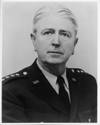
General A. C. Wedemeyer

Was he Silenced by Churchill?

  spaceYou can help with this thesis


China Commander


million people) rather than to the U.S. (with its 130 million) as an international collaborator.[1]


Looking back it is amazing how accurate Chambers was on all counts. He predicted the collapse of the Nationalists without American support, and the consequences of that collapse, i.e. the Cold War, followed by Korea and Vietnam.

This then was the situation into which Wedemeyer was thrust. To his enormous credit he approached this almost impossible mission with an open mind, and early on became convinced of the menace of the Communists, as far worse than the disorganization and admittedly corrupt Nationalists. His introduction to the Communist menace in Germany as a student conditioned him for what he was now to experience in China. Wedemeyer supported Chiang despite his knowledge of the régime’s short comings as easily the lesser of the two evils. He firmly believed that with American help, advice, and more importantly, military aid the Nationalists could win the war against the Communists, and over time the corruption could be contained. He viewed the United States foreign policy of withholding aid from the Nationalists unless they would collaborate with the Communists in forming a government and jointly fight the Japanese as a recipe for disaster and impossible of attainment. Wedemeyer saw this as a short sighted and impossible task, knowing the real objectives of the Communists were to take over China and destroy the Nationalist forces; defeat of the Japanese was secondary. Wedemeyer favored aid to the Nationalists, both military and economic, as well as strong measures to curb corruption.

 Looking at the situation objectively after the lapse of many years, and the end of the Cold War, the Korean and Vietnam conflict one could easily find fault with much of the American foreign policy in Asia both during World War II and up to the present time. Commentators have not failed to do so. When this period of our foreign policy is examined it seems to this writer that one person who understood the problems better than most and saw better than most how we should deal with the situation is Wedemeyer. It is too seldom in history that persons with visions are also allowed a opportunity to  influence policy. It is impossible to look back now at American/Chinese foreign relations  and not conclude that American policy towards China during the war, and up to 1949 when the Communists took over, was dead wrong and the consequences for America were tragic. Even the great General Marshall did not understand the situation in China, and like most in the American political establishment at the time naively thought that the Nationalist/Communist struggle was somewhat akin to the political differences between Republicans and Democrats. A little push here, a little give there, get the parties together and negotiate and with concessions from both sides a workable compromise would result. America did want a democratic China, and thought that it was attainable.


Wedemeyer’s Assignment to China as Commander of U.S. Forces

 Wedemeyer expected to stay with Mountbatten for an indefinite period, probably the end of the war, but he was in for another surprise. He received a telegram from General Marshall on October 27, 1944 directing him to proceed to China to assume command of the China theatre and replace General Stilwell who had been recalled. His immediate reaction was dismay. At this time he felt from all he had learned that this was another shove in wrong direction; the opinion of most in the military concerning China was that the difficulties in working with the Chinese were insurmountable. The word was that “…China was a graveyard for American officials, military and diplomatic; that you couldn’t do anything with the Chinese, they just wouldn’t cooperate; they led you into difficulties with your own government as well as theirs, and so on.”[2]

Wedemeyer pondered his fate, and considered the irony that he had devoted such a large portion of his time planning how to defeat the Nazis and now he was stuck in a far away theatre destined to end his career fighting the Japanese in a “secondary” military operation. It was not only the military that considered the assignment a dead end. Drew Pearson, the noted Washington columnist ridiculed the assignment in a column in the Washington Times describing Wedemeyer as spending his time “…reading Carl Sandburg’s Abraham Lincoln, and that [Wedemeyer] had been foisted into a comic opera Hollywood setting with liveried servants at [his] beck and call while the foot soldier was slogging it out in the steaming jungles of Burma.”[3]  The ink on the first telegram was hardly dry before a second telegram arrived informing Wedemeyer that the China-Burma-India theatre had been broken up into two separate commands. Wedemeyer was to command the China theatre and also serve as Chief of Staff to CHIANG KIA-SHEK; Mountbatten would remain in Command of India/Burma. Despite the “separation” there would be some overlap, and soon after Wedemeyer arrived, he had to make a decision which conflicted with Mountbatten’s wishes.

In this new assignment Wedemeyer’s primary mission was: (1) advise and assist CHIANG KIA-SHEK in the conduct of military operations against the Japanese; (2) as commander of all U.S. forces in China to conduct air operations against the Japanese; (3) assume the position of Chief of Staff to CHIANG KIA-SHEK. The telegram specifically enjoined Wedemeyer from using US resources“… for suppression of civil strife…”[4]There was no shortage of claimants to the list of those who were said to be responsible for Wedemeyer to replace Stilwell. Ambassador Hurley, as well as Vice President Wallace topped the list.[5]

When Wedemeyer actually arrived at Stilwell’s headquarters after Stilwell’s dismissal, Wedemeyer was dismayed to discover that Stilwell had intentionally departed without seeing him, and left not a single briefing paper for his guidance. Departing commanders commonly greet their replacement and thoroughly brief them on the strengths and weakness of the staff, the issues confronting them, and planned operations. Failure to do so is a serious breach of military protocol, and Wedemeyer justly levels  his harshest  criticism at Stilwell for this breach.[6]   Wedemeyer talked with Stilwell’s staff officers but learned little from them because it seems Stilwell kept everything in his “hip pocket” [7]. There was no documentary record of his plans or records of his former or future  operations to assist Wedemeyer. He was commencing his new assignment with a tabula rasa. He found himself responsible for the conduct of military operations in the most remote area far from supply sources and with the lowest priority of all theatres of


[1] Whittaker Chambers. “Crisis”an essay in Time. November 13, 1944. As was the then custom, the essays were unsigned, but it was not long before Chambers was identified as the author.

[2] Wedemeyer Reports! p. 269.

[3] Wedemeyern Reports! p. 270.

[4] Wedemeyer Reports1. p. 271.

[5] Wedemeyer Reports1. p. 277.

[6] Wedemeyer Reports! p. 303,304.

[7] Wedemeyer Reports!. p. 294.


Read more >


A. C. Wedemeyer