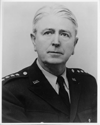
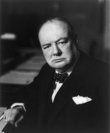
Wedemeyer first met the Prime Minister after the Victory Plan was completed, approved by the President and all the American Military Planners. In April 1942 he accompanied General Marshall and a group of American planners to London for the first of several meetings with Churchill and the British Planners. Late in his life Wedemeyer gave an exclusive interview to Keith E. Eiler, his designated biographer, entitled "The Man Who Planned the Victory." In this interview Wedemeyer records the events of that first meeting, and his early impressions of Churchill: "I found him a formidable personality. A physical, intellectual, and spiritual bulwark…He was one of the few men in high position in whose presence I felt real trepidation when I had occasion (as I did later on) to do stand up and differ with him."
In the interview, Wedemeyer recounts that when he and Marshall were returning to the United States after this first visit with the British to present their plan, General Marshall remarked that he was not satisfied that the British had really accepted the American position. They were polite, but indirect, and the nature of their questions, or more importantly, lack of questions on key points, led Marshall to remark that their approval of the plan was only with "tongue in cheek."
Later in the same interview in response to a question from Eiler, Wedemeyer relates a fascinating story of a polite and professional, but none the less, head to head disagreement with the Prime Minister, with respect to the content and recommendations of the Victory Plan, in particular the American recommendation for a cross channel invasion in the summer of 1943.
The British came to Washington for a second meeting with American Planners in June 1942, shortly after the London conference at which Wedemeyer first met Churchill and the British planners. Likely, they hurried to Washington soon after the London conference because of concern that the American plan might proceed to the point that they would not be able to head it off. They were determined to derail it.. While in Washington prior to the formal meeting, the charming Lord Louis Mountbattern and the Prime Minister each had the opportunity to spend considerable time with President Roosevelt,one on one, warning of the dangers of a too early cross channel invasion. The British capitalized on their ability to seek and obtain these extraordinary private meetings with Roosevelt, and Churchill never lost the chance to urge his strategic views on Roosevelt. Rarely, if ever, did Roosevelt have any military advisors present at these secret meetings, and there is no records were kept of what was said. The Americans, never had the opportunity to present their military views one on one to Churchiill, who took the precaution to have present at any of these meetings well qualified military as well as political advisors.
The British were determined to eliminate or at least delay, any cross channel invasion but never attacked the plan head on, only indirectly. The Prime Minister was articulate, persuasive, and a spellbinding orator. He had an outsized opinion of his strategic vision, and was determined to bring the Americans around to his viewpoint. Eiler, in the same interview tells the story of the Prime Minister's personal presentation of his strategic view on how to defeat the Nazis to key American planners, all designed to head off any cross channel invasion. This was the first "head to head" disagreement between Wedemeyer and the Prime Minister.
As Eiler tells the story, late one night without any prior notice, Wedemeyer received a telephone call from General Marshall, and he was summoned to immediately come to the White House where he and other members of the Combined Chiefs of Staff were assembled with the President and the Prime Minister. Wedemeyer recounts the experience:
There was a large colored map of the European-Mediterranean area on the wall.
The prime minister, wearing the one-piece jump suit for which he was famous, took the floor. Mustering all his eloquence he stressed the importance of squeezing Rommel out of North Africa, regaining full control of the Mediterranean, of getting Allied land forces into major action in 1942, of meeting Soviet demands for a Second Front. I recall his making a great sweeping gesture across the map, moving downward from the British Isles toward Gibraltar, eastward along the breadth of North Africa, back across the Mediterranean, and up through the Balkans into Central Europe It was a stunning performance
Wedemeyer, a lowly Lieutenant Colonel, was in the presence of the President, the Prime Minister, and the Combined British and American Chiefs of Staff of the. He was then called upon to present his view, a completely different approach. He carefully and point by point stressed the difficulties of invading Europe in the places the PM had mentioned. Wedemeyer had by carefull study learned the entire European coast and knew the logistical and tactical difficulties of invading Europe through the Balkans, as well as through Northern Italy, Norway, and the Caucasus. By all accounts his presentation was equally effective. One would have to wonder what was going through the Prime Minister's mind during Wedemeyer's presentation.
No grading points were assigned to compare Churchill's performance against Wedemeyers, and even though, in Marshall's estimation, Wedemeyer might have "won the debate" he lost the contest of wills. Roosevelt bought Churchill's view, and the cross-channel invasion was delayed from 1943 to 1944. The Mediterranean was to be the first serious Allied military expedition. As Wedemeyer later said, in his estimation, we lost "... the historic opportunity to strike a decisive, timely blow on the Continent…" On a less cosmic scale, but critically important to Wedemeyer's personal career, was this the moment when Churchill determined that this brilliant but difficult Colonel should be transferred?
Throughout his life, Wedemeyer never changed his view that the Mediterranean campaign was a diversion into a non-decisive theatre. He feared that the existence of large numbers of Allied troops in the area would consume large quantities of supplies and equipment needed for the cross channel invasion. Moreover, his worse fear, which came to realization, was that a somewhat successful venture in North Africa would lay the ground work for further Mediterranean military actions, and that is exactly what happened. Sicily followed and then Italy. Wedemeyer saw these tactics as purely diversionary, and designed to delay, if not entirely eliminate the cross channel invasion. Although Wedemeyer liked Churchill personally, and respected the Prime Minister's intellect, he rarely agreed with his military strategy, and as time passed he began to even question Churchill's intellectual integrity. After Casablanca, Wedemeyer complained to a friend: "we came, we listened and we were conquered." Later, when the PM agreed without any serious disagreement to an American in charge of OVERLORD, Wedemeyer. became so suspicious that he thought that Churchill might have wanted no part of a possible debacle for an English officer.
Read more > |